A free local tactical-shooter event in Vladivostok offers a 10,000 prize fund, while the first esports tournament in 1972 had no betting market. The lasting lesson is that format, map selection, and recent performance shape how an event should be planned and assessed. If you plan to hold an esports tournament, treat the format as your starting point.
Why the first esports tournaments still shape event formats
The first esports tournament took place in 1972. Modern events now use several structures, including single elimination, double elimination, Swiss stages, and round robins. Each format creates a different schedule and affects how many matches participants can play.
China’s national esports tournament launched in 2013 under the country’s sports authority, reaches 350 million annual viewers, and was renamed in 2023 to include virtual sports and a competition, conference, and exhibition format. Esports was recognized as an Olympic discipline in 2024, although the Olympic games themselves are currently postponed. Large events benefit from a clear format because it gives participants, sponsors, and broadcasters a stable schedule.
Format selection table for running first tournaments
| Format | Suitable use | Main planning feature |
|---|---|---|
| Single elimination | Short events with a limited schedule | One loss ends a participant’s run |
| Double elimination | Events that offer a second chance | Participants can recover after one loss |
| Swiss | Open qualifiers with many entrants | Participants play several scheduled rounds |
| Round robin | Small groups | Every participant meets the others |
Use a round robin when you have a small group and enough time for every scheduled match. For an online multiplayer strategy tournament with more than 600 players, a Swiss or double-elimination format can provide more matches than a single bracket.
Team form: performance over prize pool
Petropavlovsk hosted its first major tactical-shooter tournament with support from a regional federation and local administration. The event was intended to help establish a complete esports development system in the region, rather than serve as a ranking source.
A free online multiplayer strategy series previously attracted more than 600 players. If you record bans, match length, and map results, you can build a small form database. Those records help organizers understand participation and performance without relying on prize-pool size alone.
A LAN tournament in Moscow used individual scoring with provided accounts, so there was no team veto. The top three players received a vehicle prize, while the top 30 received in-game currency. For individual-score events, organizers should track personal performance and the event’s map or match structure instead of using a head-to-head team comparison.
Map analysis before you hold an esports tournament
Before you hold an esports tournament, write down the map-selection order and publish it with the rules. In a tactical shooter, a team’s choice to remove an opponent’s strongest map can change the balance of a series. In a multiplayer strategy game, early draft choices can influence the rest of the match because teams may adjust bans and lane assignments after the opening game.
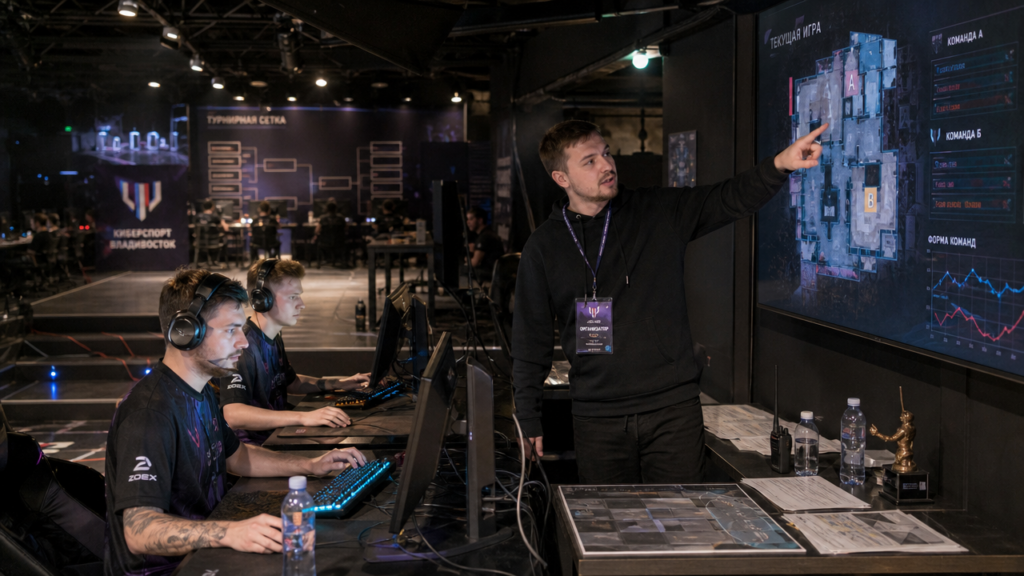
A free tactical-shooter event in Vladivostok is scheduled for February 24 at 19:30, with limited registration through a profile biography or pinned comments. Events with mixed local teams can provide useful data when organizers record map results, player participation, and series length.
How to hold an esports tournament with sponsor-ready structure
To hold an esports tournament that attracts sponsors, treat the format and data as part of the product. The organizer of a free online multiplayer strategy event had platform partners and previously attracted more than 600 players. To build sponsor interest, the organizer needed connections, a portfolio, unique content, a clear presentation, and sufficient resources.
Start with a free online qualifier, fix the map-selection rules, and publish match records. A round robin works for a small group, while a Swiss stage suits a larger open registration. The first esports tournaments showed that a readable, repeatable, and affordable structure can make an event easier to run and follow.